
SCOM Managed Instance has retired. Here is where that leaves your management group.
Azure Monitor SCOM Managed Instance was deprecated on 30 September 2026. Microsoft has archived its documentation, and the overview page now states plainly that the service is no longer in support.
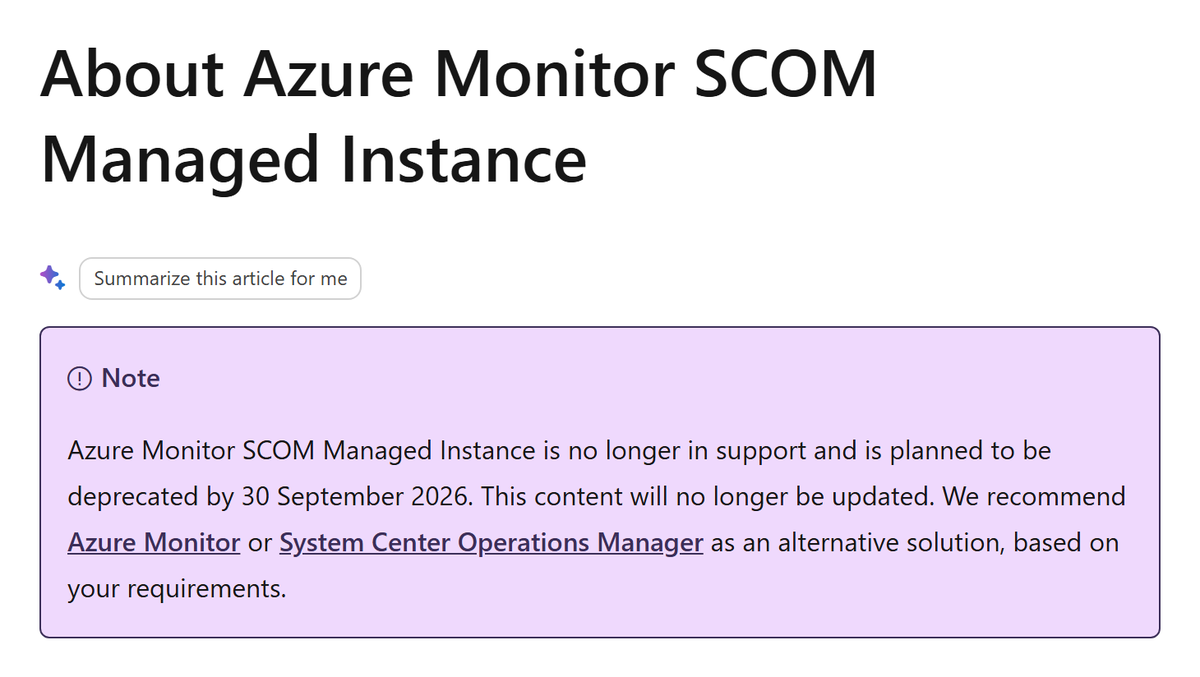
Microsoft’s guidance names two alternatives: Azure Monitor, or System Center Operations Manager, depending on your requirements. That second one deserves attention, because for a large number of estates it is the only one of the two that actually fits.
What this is, and what it is not
This is not Microsoft abandoning monitoring, and it is not a verdict that cloud monitoring failed. Azure Monitor is a capable product and for cloud-native workloads it is frequently the right answer.
What ended is the specific idea that you could take a System Center Operations Manager estate, lift it into a Microsoft-managed cloud service, and carry on. That path is closed.
If you were running SCOM Managed Instance
You need a plan this quarter, not this year. Two routes:
Back to on-premises SCOM. Your management packs come with you, because SCOM Managed Instance ran the same engine and supported the same agent-based packs. Your agents, your overrides, your tuning and your institutional knowledge all still apply. This is the shortest distance between where you are and something supported.
Forward to Azure Monitor. Realistic if your estate has genuinely moved to Azure and your monitoring needs have moved with it. Less realistic if you are monitoring domain-joined Windows servers, SQL Server, IIS, Active Directory and DNS on hardware you own, using packs written for exactly that. There is no management pack import on the other side.
Most SCOM estates are the second description, which is why on-premises is on the list at all.
If you deferred SCOM investment waiting to see how this played out
It played out.
Plenty of teams spent the last two years being told that SCOM was a legacy platform on the way out, and postponed upgrades, tuning work and tooling decisions on that basis. Some of those teams are now running SCOM 2019 on Windows Server 2016, with a monitoring estate nobody has been allowed to invest in, because the strategy was to move to something else.
The something else is deprecated. SCOM 2025 shipped in Q4 2024, supports Windows Server 2025 and SQL Server 2022, and is in mainstream support until January 2030, with extended support until January 2035. If your organisation is running SCOM, it is going to keep running SCOM, and that is now a decision someone can defend rather than apologise for.
What we would actually do this quarter
- Get current. If you are on 2019 or 2022, plan the 2025 upgrade. The support runway is the whole point of the exercise.
- Find out what you are actually monitoring. Most estates have years of accumulated overrides and half-remembered tuning. You cannot make good decisions about a system you cannot see the configuration of.
- Fix the day-to-day experience. The most common complaint about SCOM has never been the monitoring engine. It is what it takes to work with it: a Windows-only console, installed per machine, that service owners never get access to and on-call reaches through a jump box.
That third point is why we built SCOM Pulse. It is a browser-based operations console for Operations Manager: alert investigation with the reason each alert fired, an inline Health Explorer, the effective configuration of any server, Windows agent deployment, overrides, maintenance on a calendar and management group administration. It runs against the management group you already have, uses your existing SCOM user roles and Windows Authentication, and makes no outbound internet calls. It includes our Maintenance Mode Scheduler.
The trial is 30 days, needs no licence key and no sales call. Download the trial · See what it does
The short version
The cloud-hosted version of SCOM is gone. On-premises SCOM is supported, current, and for most of the estates that were considering the move, it is the option that actually fits. If you have been treating your management group as a system in wind-down, it is worth revisiting that.
We have been building tools for Operations Manager since 2007. We did not expect the argument to be settled quite this cleanly.